
Maths
tutoring
Maths from Year 7 through to HSC Extension 2.
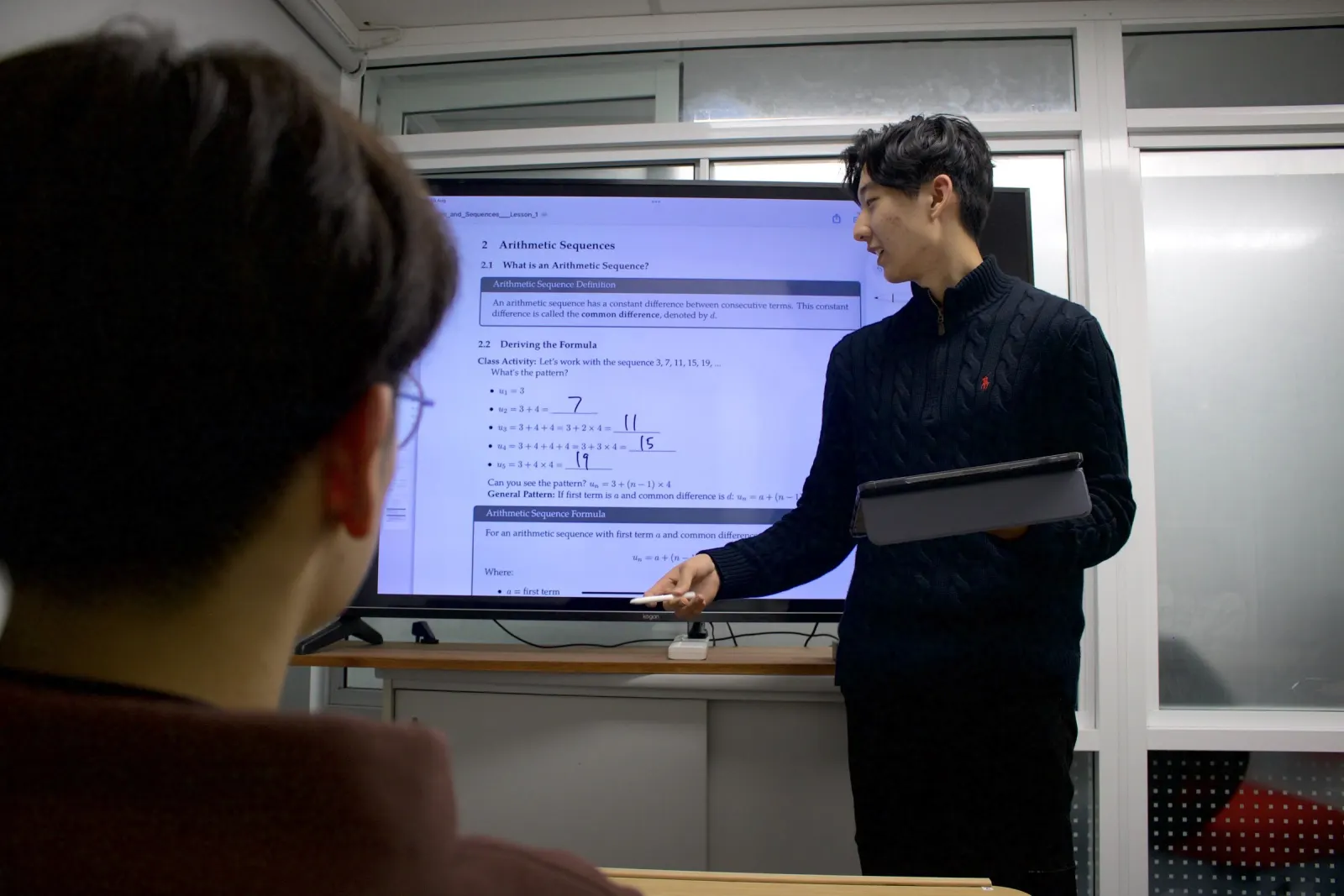
How the lessons work
The tutor explains the topic and works through examples with the group. Students then practise, ask questions and get help with the steps they’re finding difficult.
What we work on
- Number, algebra and proportional reasoning
- Geometry, measurement and problem-solving
- Senior Mathematics Advanced
- Mathematics Extension 1 and Extension 2
What changes by year level
Years 7–8: connect numbers, rules and graphs
Build confidence with number, algebra, geometry and measurement. Our Year 8 materials connect a growing pattern to a table, an algebraic rule and a straight-line graph. Students practise explaining how those representations describe the same relationship.
Years 9–10: choose a method and show the working
Our materials include right-angled trigonometry in Year 9 and similarity, coordinate geometry, polynomials and non-linear relationships in Year 10. The focus is on recognising which method fits, carrying it out accurately and checking whether the answer makes sense.
Year 11: Advanced and Extension 1
Mathematics Advanced builds on algebra through functions, graph transformations and introductory calculus. Extension 1 requires further reasoning, including topics such as permutations and combinations. Tell us your school course when you enquire so we can discuss the appropriate level.
Year 12: Advanced, Extension 1 and Extension 2
Work is matched to the course you take. Our senior materials include calculus and financial mathematics for Advanced, proof by induction and vectors for Extension 1, and complex numbers and proof for Extension 2. Extension 2 is a Year 12 course; it is not part of the junior Maths program.
Topics and pace depend on your child’s starting point and school course. At the free diagnostic in Epping, we discuss the next steps and confirm suitable class options.
A look inside our teaching materials
Year 8 example: from a pattern to a rule
Our Linear Relationships booklet uses a row of matchstick triangles. The first triangle needs three matches; each new triangle shares a side and adds two.
- Count: the first five shapes use 3, 5, 7, 9 and 11 matches.
- Explain: the total rises by two each time, but the first shape starts at three. For shape n, the rule is m = 2n + 1.
- Check: shape 5 gives 2 × 5 + 1 = 11. Connecting the picture, table and rule makes it easier to spot a missing starting value.
Adapted from BEAM’s Year 8 Linear Relationships materials. This is a teaching example, not a student result.
Year 8 guide: finding a linear rule
How feedback and practice work between lessons
Find a lesson time
Choose a year to narrow the published Maths timetable.
Published timetable snapshot, 23 October 2026. Confirm current times and availability with the team.
Your tutors
Taehoon Kim and Chris Kim
Meet the teaching teamYour first visit
Start with a free diagnostic. We’ll go through the results with you and recommend a class based on what your child needs.
Book a free diagnosticAllow 1 hour 20 minutes. It’s free, with no obligation to enrol.
A diagnostic paper 1 hour
Your child completes a paper so we can see what they understand and which topics need more work.
Discuss the results
We mark the paper and go through the topics with you, including where your child got stuck.
Choose a class
We’ll explain the class options, times and fees. You can ask questions and decide whether you’d like to enrol.